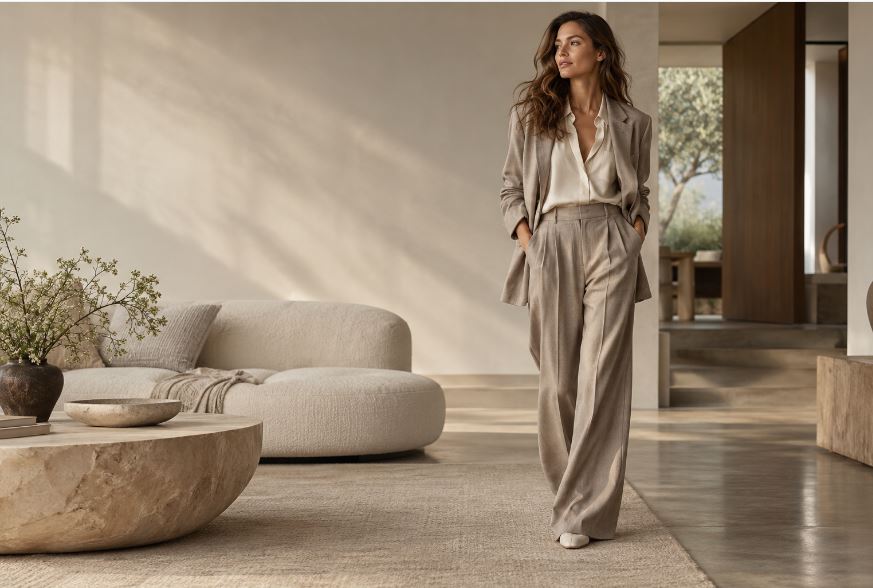
You know the outfit.
It looks beautiful in the mirror. The color flatters you, the silhouette feels current, and every detail appears carefully chosen. You leave home feeling confident.
Then the day begins.
The waistband presses into your stomach when you sit. A seam rubs against your skin. The sleeves need constant adjusting. The fabric traps heat, the shoes change the way you walk, and the necklace seems to become heavier with every passing hour.
By evening, the outfit that looked perfect in the morning has become something you cannot wait to remove.
This experience reveals an overlooked truth about personal style: an outfit can look right and still be wrong for your life.
We have spent years learning how clothes should photograph, flatter and coordinate. We know about proportions, color palettes and wardrobe essentials. Yet we rarely ask a simpler question:
How does this outfit make my body feel after six hours?
That question is the beginning of sensory style — a more thoughtful way of dressing that considers movement, temperature, pressure, texture and attention alongside appearance.
It is not about abandoning elegance for oversized sweatpants. It is about recognizing that the most successful clothes do two things at once: they look intentional and allow you to live normally inside them.
The Mirror Only Shows the First Five Minutes
A mirror can tell you whether a jacket defines your shoulders or whether a dress works with your proportions. It cannot tell you how the same outfit will feel after a commute, two meetings, lunch, a long walk and several hours of sitting.
Most disappointing clothing purchases are not necessarily unattractive. They fail because they were evaluated in a moment rather than tested in a real day.
In a fitting room, you stand upright under carefully positioned lighting. You rarely climb stairs, carry a bag, reach for something above your head or sit for twenty minutes. You may not notice that a neckline moves, a skirt twists or a shoe begins to press against one specific toe.
The garment passes the visual test but fails the life test.
This is why some clothes remain technically beautiful while spending years untouched in the wardrobe. We remember how they look, but our bodies remember how they feel.
The Hidden Cost of an Irritating Outfit
Physical discomfort does not always arrive as obvious pain. Often, it appears as a series of small interruptions:
- pulling down a top every time you stand;
- checking whether a neckline has shifted;
- loosening a waistband after lunch;
- lifting a bag strap away from a sensitive shoulder;
- avoiding longer walks because of your shoes;
- wondering whether the fabric looks as wrinkled as it feels;
- adjusting sleeves, straps, belts or jewelry throughout the day.
None of these problems seems dramatic on its own. Together, however, they consume attention.
A good outfit should support your presence, not repeatedly demand it. You should be able to participate in a conversation, focus on your work and move through the day without constantly managing your clothes.
When an outfit requires supervision, it is no longer serving you. You are serving it.
What Sensory Style Actually Means
Sensory style is the practice of considering how clothing interacts with the body during real life.
It asks more precise questions than “Is this comfortable?” because comfort is not one single quality. It is a combination of several factors.
1. Pressure
Where does the garment hold the body?
A structured waistband may feel supportive to one person and restrictive to another. A fitted collar can look sophisticated while creating tension around the neck. Tight elastic, narrow armholes and rigid cuffs may become increasingly noticeable as the day continues.
Pressure also changes depending on what you are doing. Trousers that feel perfect while standing may become uncomfortable when you sit.
2. Friction
Friction occurs wherever fabric, hardware or footwear repeatedly moves against the body.
A small internal label, rough seam, stiff edge or exposed zipper may seem insignificant in the morning. After several hours, it can become the only thing you notice.
This is also why two garments made from the same fabric can feel entirely different. Construction matters as much as material.
3. Temperature
An outfit can be visually appropriate for the season and still create the wrong personal climate.
Synthetic lining may trap heat. Heavy layering can feel comfortable outdoors but unbearable inside a warm office. A beautiful knit may be too insulating for a day that involves public transport, walking and heated rooms.
Temperature comfort depends on the complete outfit, not only the main garment.
4. Movement
Can you sit, bend, walk quickly, raise your arms and carry your usual bag?
Clothing does not need to be stretchy to allow movement, but it needs enough space in the correct places. A tailored jacket can feel effortless when its armholes and back are well designed. A loose garment can still restrict movement if it pulls at the shoulders or twists around the body.
5. Mental Attention
Some clothes make us feel exposed even when they fit correctly.
A very light-colored outfit may create anxiety about stains. A short hemline can lead to constant checking. A dramatic accessory may feel exciting for an hour and exhausting for an entire day.
Sensory comfort therefore includes emotional ease. The goal is not invisibility. It is freedom from unnecessary self-monitoring.
Your Most-Worn Clothes Are Already Giving You the Answer
Before buying anything new, examine the clothes you wear repeatedly.
Do not ask only why they look good. Ask why they feel easy.
Perhaps your favorite trousers have a soft waistband and enough room when you sit. Maybe your most reliable blouse has sleeves that stay in place without restricting your arms. Your preferred coat may be successful because it fits over knitwear without becoming heavy.
These details are not accidental. They form your personal comfort profile.
Look for patterns in four categories:
- Shapes: Do you prefer relaxed, straight, fitted or gently structured silhouettes?
- Textures: Which fabrics feel reassuring, and which do you remove after an hour?
- Closures: Do you prefer elastic, buttons, zippers, wrap designs or pull-on styles?
- Weight: Do heavier garments feel grounding or tiring?
Your most-worn clothes may not be the most exciting pieces in your wardrobe, but they contain valuable information. They reveal what your body accepts without negotiation.
Stop Shopping for the Life That Exists Only in Your Imagination

Many uncomfortable garments are purchased for an imagined version of daily life.
We buy the delicate blouse for calm mornings, although our real mornings involve rushing. We choose shoes for elegant arrivals, forgetting how much walking happens before we reach the destination. We purchase a rigid handbag because it photographs beautifully, even though we dislike carrying anything heavy.
The problem is not aspiration. Clothing can help us express new sides of ourselves. The problem begins when every purchase is designed for a fantasy and almost none supports reality.
Before buying a garment, imagine three specific situations:
- How will it feel during transportation?
- How will it behave when you sit?
- Will you still want to wear it at the end of the day?
This does not make fashion less creative. It makes your wardrobe more honest.
The Ten-Minute Fitting Room Test
A quick glance is not enough to judge a garment. If you are seriously considering a purchase, test it as if you already own it.

Sit down properly
Do not perch on the edge of a fitting-room stool. Sit as you would at work or in a restaurant. Notice the waist, hips, buttons and neckline.
Raise both arms
Check whether the entire garment moves upward or restricts your shoulders. A well-fitting piece should recover its position without extensive adjustment.
Walk at your natural speed
Take longer steps if space allows. Pay attention to twisting skirts, trousers that pull at the knees and shoes that alter your stride.
Reach and bend
Imagine taking something from a shelf or picking up a dropped object. Does the garment still provide the coverage and movement you need?
Wear your actual outer layer
If you will wear the piece beneath a coat or jacket, try the combination. Two individually comfortable garments can become restrictive when layered.
Carry your usual belongings
A top may feel perfect until a crossbody strap presses its seam against your shoulder. A coat may work without a bag but feel crowded once you add one.
Ten thoughtful minutes can prevent years of owning something you admire but avoid.

Fabric Names Do Not Tell the Whole Story
It is tempting to divide fabrics into simple categories: natural is good, synthetic is bad, expensive is comfortable, inexpensive is not.
Real clothing is more complicated.
Fiber content matters, but so do thickness, weave, finishing, lining and construction. Cotton can feel soft or rigid. Wool can feel smooth or irritating. Viscose can feel fluid but behave differently depending on the fabric’s weight. Polyester can trap heat in one garment and perform perfectly well in another.
Instead of trusting a label alone, use your senses.
Hold the fabric against the inside of your wrist or neck. Compress it gently in your hand. Look at how quickly it releases wrinkles. Check whether it feels smooth in both directions. Inspect the inside of the garment, not only the visible surface.
Your skin experiences the inside. That is where quality must also exist.
Fit Is Not a Moral Judgment
One of the most damaging ideas in fashion is that a person should tolerate discomfort because a particular size technically closes.
If you cannot breathe normally, sit comfortably or move naturally, the label is irrelevant.
Choosing a larger size is not failure. Choosing a smaller size is not success. Clothing sizes are inconsistent tools used by manufacturers; they are not measurements of discipline, beauty or personal worth.
The correct size is the one that allows the intended silhouette to appear without forcing your body to remain unnaturally still.
Sometimes the problem is not size but proportion. A garment may fit at the waist and fail at the shoulders. It may fit the hips but leave too much space elsewhere. Tailoring can solve some issues, but not every garment deserves alteration.
The goal is not to make your body fit the clothes. It is to select clothes designed closely enough to fit your body.
The Details That Quietly Decide Whether You Wear Something
Small construction details often determine whether a garment becomes a favorite or a regret.
Before purchasing, inspect:
- the position and texture of internal seams;
- whether the lining covers rough areas;
- the weight of buttons, buckles and zippers;
- whether decorative hardware touches the skin;
- how the waistband behaves when stretched;
- whether labels can be removed safely;
- how straps sit with your usual bra;
- whether pockets add bulk or practical value;
- how the hem moves while walking.
These features rarely create excitement in a product photograph. Yet they strongly influence how often you will wear the garment.
Comfort Does Not Have to Look Casual
The word “comfortable” is often associated with clothing that is oversized, sporty or intended for home. That definition is far too narrow.
A polished outfit can feel easy when it is built thoughtfully.
For work
Try fluid trousers with a stable waistband, a smooth base layer and an unlined or softly constructed jacket. The outfit still has definition, but nothing needs constant correction.
For a long city day
Choose a breathable top, a skirt or trousers that allow a full walking stride, supportive shoes and a lightweight bag that leaves your hands free.
For dinner
A draped dress, soft tailoring or an elegant knit set can create evening presence without relying on restrictive shaping.
For travel
Use light layers with different temperature functions rather than one heavy piece. Choose fabrics that recover reasonably well after sitting and shoes that remain comfortable when feet naturally change during the day.
Elegance does not come from suffering successfully. It comes from control, coherence and ease.
When Is Discomfort Worth It?
Not every item needs to perform for twelve hours.
There may be shoes you happily wear for a short dinner, a structured dress reserved for special occasions or jewelry that feels appropriate only for a few hours. Fashion can be theatrical, emotional and occasionally impractical.
The important difference is whether the discomfort is chosen consciously.
A special garment becomes a problem when you buy it for everyday life but can only tolerate it for photographs. If you understand its limits and have an appropriate occasion, it may still deserve a place in your wardrobe.
Ask one honest question:
Do I love this enough to accept the way it feels — and do I genuinely have a life in which I will wear it?
If the answer is unclear, admiration may not be a good reason to purchase it.
Try a Seven-Day Sensory Wardrobe Audit
For one week, pay attention to how your clothes behave rather than how they look in the morning.
At the end of each day, make three short notes:
- What did I adjust?
- What did I stop noticing because it worked?
- What did I remove first when I came home?
Patterns will emerge quickly.
You may discover that you dislike heavy jewelry, narrow sleeves or slippery shoulder straps. Perhaps your feet tolerate a certain heel height but not a particular shoe shape. You may learn that you need softer waistbands after lunch or lighter layers in heated buildings.
Use this information when planning future outfits and purchases.
A wardrobe becomes easier not when it contains every possible option, but when fewer pieces repeatedly create physical and visual harmony.
The New Luxury Is Forgetting About Your Clothes
The most successful outfit is not always the one that receives the most compliments. Sometimes it is the one that allows you to forget what you are wearing.
You enter a room without pulling at your hem. You sit without loosening a button. You walk without calculating the distance. You listen, speak, work and laugh without part of your attention remaining trapped inside an irritating sleeve.
That freedom changes how style appears from the outside.
When you are not managing discomfort, your posture becomes more natural. Your movement becomes calmer. You stop touching your clothes and begin engaging more fully with the world around you.
This is why sensory comfort is not separate from elegance. It is one of its foundations.
Looking good may create the first impression. Feeling at ease determines everything that happens afterward.
The future of personal style is not about choosing between beauty and comfort. It is about refusing to accept clothes that offer only one.