
Some items fit only one occasion, others require shoes or accessories you do not own, and many remain untouched because they do not match your real lifestyle.
A functional wardrobe is not necessarily small, expensive or perfectly coordinated. It is a collection of clothes that supports your daily life, feels comfortable, reflects your personality and makes getting dressed easier.
This guide presents a practical method for understanding what you already own, identifying the real gaps in your wardrobe and making future purchases more intentional.
What Makes a Wardrobe Functional?
A functional wardrobe has four essential qualities:
- Most pieces can be combined with several other items.
- The clothes match the activities that actually fill your week.
- The fit and fabrics feel comfortable enough for regular wear.
- Your wardrobe reflects your preferences instead of copying a temporary trend.
This does not mean every garment must be basic or neutral. Statement pieces, unusual colors and distinctive accessories can play an important role. The goal is simply to make sure that the majority of your wardrobe supports them rather than competes with them.
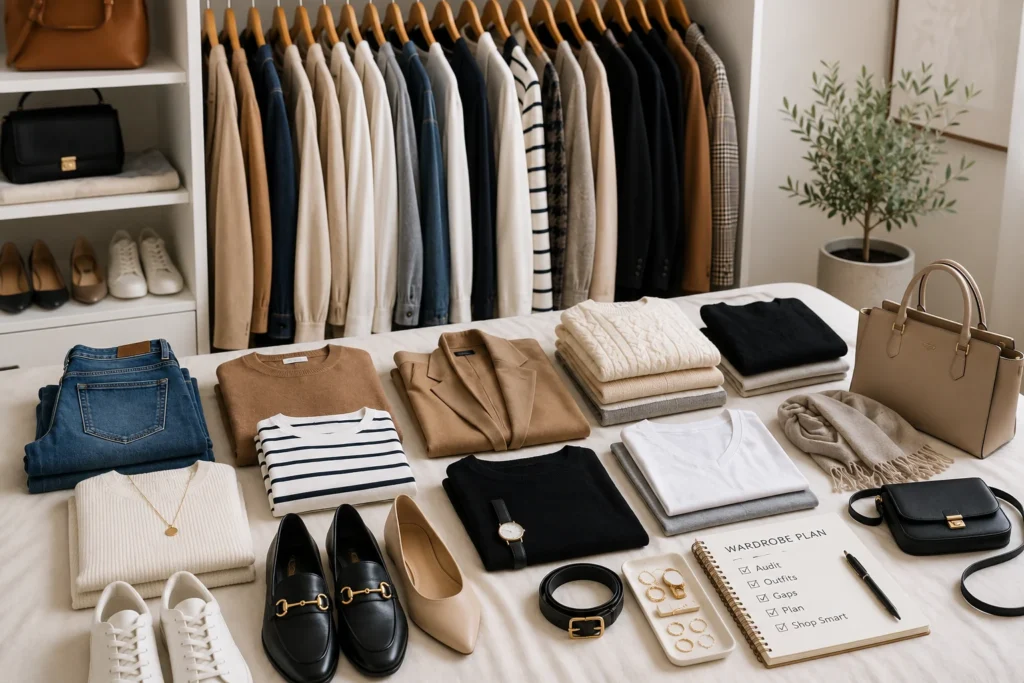
Step 1: Start With Your Real Life, Not Your Ideal Life
Before sorting your clothes, write down how you normally spend a typical month. Avoid building a wardrobe for an imaginary lifestyle.
You may love elegant evening dresses, tailored suits or dramatic heels, but if most of your time is divided between work, errands, walking and casual meetings, these categories should receive more space in your wardrobe.
Create a Lifestyle Map
Estimate the percentage of time you spend in each type of situation:
| Activity | Approximate share of your time | Typical clothing needs |
|---|---|---|
| Work or study | 40% | Comfortable, presentable everyday outfits |
| Home and errands | 25% | Easy-care casual clothing |
| Social activities | 15% | Relaxed but polished combinations |
| Exercise or outdoor activities | 10% | Practical sportswear and outerwear |
| Formal occasions | 10% | A limited number of dependable dressier outfits |
Your numbers may be completely different. The value of this exercise is not mathematical precision. It helps reveal whether your wardrobe is serving your actual routine.
For example, if formal events represent only five percent of your life but evening clothes occupy a quarter of your wardrobe, you may have found one reason why your closet feels full yet impractical.
Step 2: Complete a Wardrobe Audit
A useful wardrobe audit is more than a large cleaning session. It is a way to collect information about your habits.
Work with one category at a time: trousers, shirts, knitwear, dresses, jackets, shoes and accessories. Trying to evaluate everything at once can become tiring and lead to rushed decisions.
Place Each Item Into One of Five Groups
1. Regularly worn
These pieces fit well, feel comfortable and work with your routine. They form the foundation of your wardrobe.
2. Useful but rarely worn
These may be seasonal garments, formal clothes or items for specific activities. They can remain if they serve a clear purpose.
3. Needs repair or alteration
A loose button, damaged hem or slightly incorrect length can prevent a good garment from being worn. Place these items in a separate bag and set a realistic deadline for fixing them.
4. Difficult to style
These are pieces you like but rarely wear because they do not combine easily with the rest of your wardrobe. Do not remove them immediately. First determine what is missing.
5. No longer suitable
This group may include uncomfortable clothes, items that no longer match your life or garments you repeatedly avoid wearing. Depending on their condition, they can be donated, sold, recycled or repurposed.
Ask Better Questions
Instead of asking only, “Do I like this?” consider the following:
- Have I worn it during the appropriate season?
- Can I create at least three outfits with it?
- Does it feel comfortable after several hours?
- Does it require constant adjusting?
- Does it work with the shoes and outerwear I own?
- Would I choose it again today?
- Am I keeping it because I use it or because I feel guilty about the money spent?
An item can be attractive and still be wrong for your wardrobe. Recognizing that difference is one of the most useful style skills.
Step 3: Identify Your Most Successful Outfits
Your favorite outfits contain valuable information. Instead of searching for an entirely new personal style, study the combinations that already make you feel confident.
Choose five to ten outfits you regularly enjoy wearing and photograph them. Then look for repeated elements.
You may notice that you prefer:
- straight rather than oversized silhouettes;
- high-waisted trousers;
- open necklines;
- soft layers;
- structured jackets;
- low-contrast color combinations;
- simple clothing with one distinctive accessory.
These patterns form your personal style formula.
Examples of Style Formulas
A style formula is not a uniform that removes creativity. It is a dependable structure that can be changed through fabrics, colors and accessories.
- Straight-leg trousers + fitted knit top + relaxed blazer + loafers
- Midi skirt + simple T-shirt + cropped jacket + ankle boots
- Dark jeans + button-up shirt + long coat + clean sneakers
- Simple dress + cardigan + structured bag + flat shoes
- Wide-leg trousers + tucked-in top + belt + minimal jewelry
Having two or three reliable formulas makes everyday dressing faster while still allowing variety.
Step 4: Build a Personal Color System
A coordinated wardrobe does not require limiting yourself to beige, black and white. It requires colors that can communicate with one another.
Choose Three Color Groups
Foundation colors
These are the shades used for larger and frequently worn pieces such as trousers, coats, jackets and shoes. Examples include navy, charcoal, cream, brown, olive, black or denim blue.
Supporting colors
These add variety while remaining easy to combine. Depending on your taste, they may include burgundy, soft blue, rust, forest green, dusty rose or warm gray.
Accent colors
These are brighter or more distinctive shades used in smaller amounts through tops, scarves, bags, jewelry or statement pieces.
The objective is not to follow a universal palette. Choose colors you genuinely enjoy and can realistically combine.
Test the Palette Before Buying
When considering a new item, imagine it next to the clothes already in your wardrobe. Ask:
- Can I wear this color with at least two of my foundation colors?
- Does it work with my main coat?
- Do I already own suitable shoes and a bag?
- Will it require an entirely new set of supporting pieces?
A garment that requires several additional purchases is often more expensive than its price tag suggests.
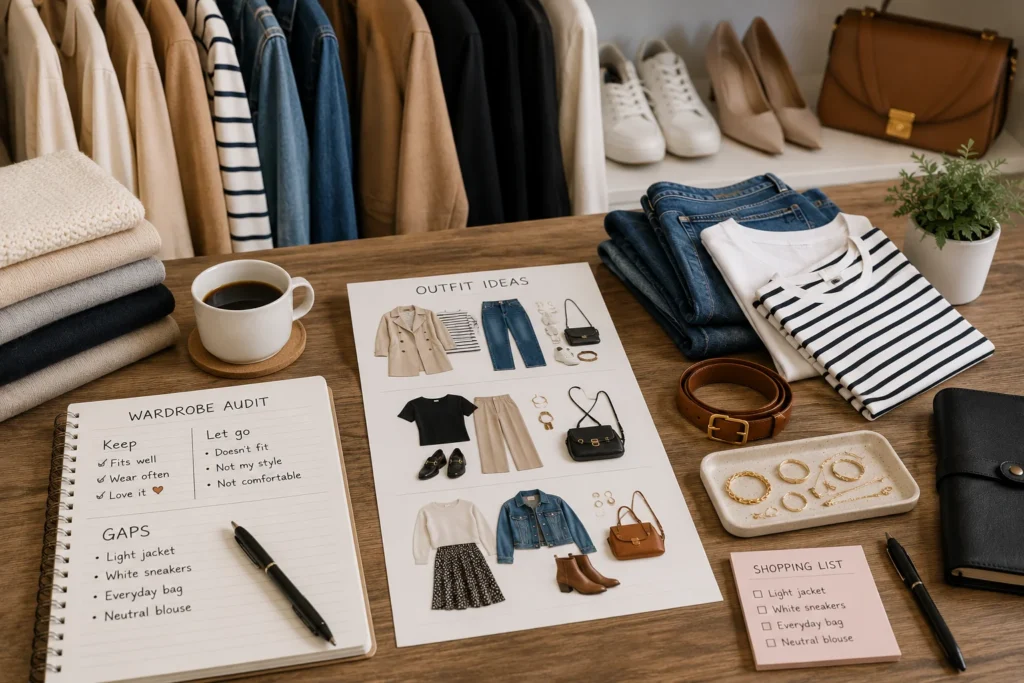
Step 5: Find the Real Wardrobe Gaps
After completing the audit, avoid immediately buying more clothes. First create complete outfits with what you own.
Lay out or photograph combinations for work, casual days, social occasions and different weather conditions. You will begin to see repeated obstacles.
A real wardrobe gap is specific. “I need more clothes” is not a useful conclusion. Better examples include:
- a comfortable shoe that works with both trousers and skirts;
- a light layer for air-conditioned rooms;
- a neutral top that works under three existing jackets;
- a practical bag for daily use;
- a winter coat long enough to cover your most-worn dresses;
- a belt that improves the fit of several outfits.
Use a Priority List
Divide potential purchases into three levels:
| Priority | Meaning | Example |
|---|---|---|
| Essential | Solves a repeated daily problem | Comfortable work shoes |
| Helpful | Creates several additional combinations | A versatile cardigan |
| Optional | Adds interest but is not currently necessary | A trend-driven accessory |
This method prevents exciting but low-use purchases from taking priority over the items that would improve your wardrobe every week.
Step 6: Use the “Three-Outfit Rule” Carefully
Before buying a garment, identify at least three complete outfits you can create with pieces you already own.
Do not count small variations as separate outfits. Wearing the same shirt with three nearly identical pairs of jeans does not necessarily demonstrate versatility.
A more useful test is to see whether the item works across different combinations or situations.
For example, a jacket might work with:
- trousers and loafers for work;
- jeans and sneakers for a casual day;
- a simple dress and ankle boots for dinner.
If you cannot visualize complete outfits, save a photo of the item and reconsider it later. Distance often makes the decision clearer.
Step 7: Evaluate Fit Beyond the Changing Room
A garment can look good for two minutes in front of a mirror and still become uncomfortable during normal movement.
When trying something on, test it as you would use it:
- sit down;
- raise your arms;
- walk several steps;
- check whether the fabric pulls;
- notice whether straps or waistbands move;
- look at the garment from the side and back;
- try it with the undergarments or layers you would normally wear.
Also consider maintenance. A beautiful garment that requires care you are unwilling or unable to provide may spend most of its life unworn.
Step 8: Understand Cost Per Wear
Price alone does not tell you whether an item offers good value.
A simple way to evaluate a purchase is:
Cost per wear = purchase price ÷ number of times worn
A coat purchased for $180 and worn 120 times costs approximately $1.50 per wear. A special top purchased for $40 and worn twice costs $20 per wear.
This does not mean every purchase must achieve the lowest possible cost per wear. Clothing can also provide enjoyment, creativity and emotional value. However, this calculation helps distinguish frequently useful pieces from purchases that only seem inexpensive.
Step 9: Create a Wardrobe Maintenance Routine
A functional wardrobe requires regular attention, but it should not require constant shopping.
Weekly
- Return clean clothing to the correct place.
- Air out jackets, knitwear and shoes when needed.
- Set aside anything requiring small repairs.
- Photograph an outfit that worked especially well.
Monthly
- Review the items you repeatedly avoid.
- Check whether your purchase list still reflects real needs.
- Clean frequently used shoes and bags.
- Remove empty hangers and reorganize crowded sections.
Seasonally
- Store clean off-season clothes properly.
- Review fit, condition and relevance before returning items to storage.
- Plan repairs before the next season begins.
- Identify one or two meaningful gaps rather than creating a long shopping list.
A Seven-Day Wardrobe Reset
If a complete wardrobe overhaul feels overwhelming, use this manageable one-week plan.
Day 1: Define Your Lifestyle
Complete the lifestyle map and list the situations for which you dress most often.
Day 2: Audit Tops and Knitwear
Separate regularly worn pieces, difficult items and anything needing repair.
Day 3: Audit Bottoms and Dresses
Check fit, comfort and how easily each item combines with your tops.
Day 4: Review Shoes, Bags and Outerwear
These items often determine whether an outfit is genuinely practical.
Day 5: Create and Photograph Ten Outfits
Use only what you already own. Include combinations for different parts of your life.
Day 6: Write a Precise Shopping List
List only items that solve a repeated problem or unlock several outfits.
Day 7: Organize for Visibility
Place frequently worn items where they are easy to see. A useful garment cannot help you if it remains forgotten at the back of a shelf.
Common Wardrobe-Building Mistakes
Buying for a fantasy version of yourself
It is reasonable to prepare for future goals, but the majority of your wardrobe should serve your current life.
Choosing every item as a statement piece
Distinctive garments need simpler supporting pieces. Without them, a wardrobe can contain many beautiful items but very few complete outfits.
Buying duplicates without understanding why
Owning several similar items is not automatically wasteful. If you regularly wear white shirts or dark trousers, duplicates may be practical. The problem begins when multiple versions remain unworn because none fits properly.
Ignoring outerwear and footwear
An outfit that works only without a coat or with shoes you cannot comfortably wear is not a complete everyday outfit.
Following rules that do not match your preferences
Capsule wardrobes, color analysis and trend reports can be useful tools, but they should not replace personal judgment. A successful wardrobe is one you enjoy using.
Questions to Ask Before Every Purchase
- Where will I realistically wear this?
- Can I create three complete outfits with it?
- Does it work with my existing shoes and outerwear?
- Is the fit comfortable while sitting and moving?
- Can I maintain the fabric properly?
- Do I already own something that serves the same purpose?
- Am I buying it because it fills a need or because it is discounted?
- Would I still want it if it were not currently trending?
- Can I imagine wearing it at least 20 times?
- Does it feel like me?
Final Thoughts
Building a useful wardrobe is not about achieving perfection or following a rigid number of items. It is about understanding the relationship between your clothes and your life.
When you know which silhouettes feel comfortable, which colors combine easily and which activities require the most support, shopping becomes less confusing. You stop searching for random “must-have” items and begin choosing garments with a clear purpose.
The most successful wardrobe is not the one that attracts the most attention online. It is the one that quietly helps you get dressed, feel like yourself and move through your day with less stress.
Printable Wardrobe Audit Checklist
- I have identified the main activities in my weekly routine.
- I know which clothes I wear most often.
- I have separated garments requiring repair or alteration.
- I can name at least two reliable outfit formulas.
- I have selected my main foundation and supporting colors.
- I have photographed several successful outfits.
- I have written a specific, prioritized shopping list.
- I can create complete outfits with suitable shoes and outerwear.
- I understand which purchases have been least useful and why.
- I have created a simple monthly maintenance routine.