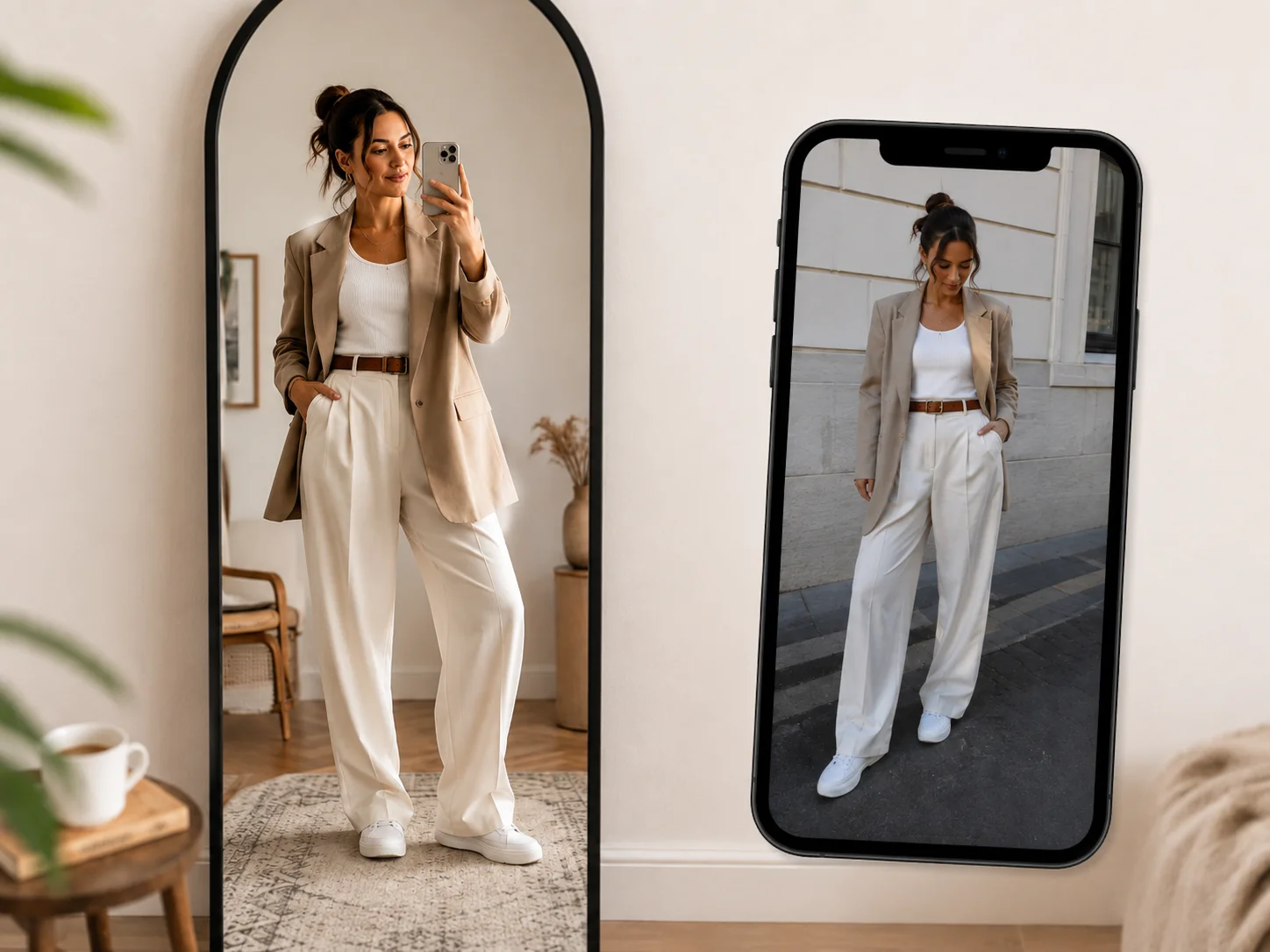
You get dressed, look in the mirror and think: perfect.
The trousers fall exactly the way you wanted. The jacket creates a clean silhouette. The shoes work. The proportions feel balanced.
Then someone takes a photo.
Suddenly, the jacket looks too wide, your legs seem shorter, the trousers appear heavier and an outfit that looked effortless five minutes ago somehow feels completely wrong.
The natural reaction is usually:
“Maybe these clothes just don’t suit me.”
But that is often the wrong conclusion.
A mirror and a camera do not show an outfit in the same way. Understanding that difference can save you from replacing perfectly good clothes — and can dramatically improve the way your outfits look in everyday photos.
The Mirror Gives You Something a Photo Cannot: Movement
When you look at yourself in a mirror, you rarely stand completely still.
You turn slightly.
You adjust your shoulders.
You move your hair.
You take a step back.
You look at your outfit from several angles without even realizing it.
Your brain combines all of those tiny movements into one overall impression.
A photograph does the opposite.
It takes one fraction of a second and freezes it forever.
If your jacket happens to fold awkwardly at that exact moment, the fold becomes part of the image.
If your weight is distributed strangely between your feet, that becomes your silhouette.
If a skirt moves beautifully when you walk but collapses when you stop, the photograph records only the collapsed version.
This is one reason an outfit can feel much better in real life than it looks in one random photo.
The Biggest Problem May Be the Camera, Not the Clothes
Phone cameras are incredibly convenient, but convenience comes with one styling problem: people often photograph full outfits from too close.
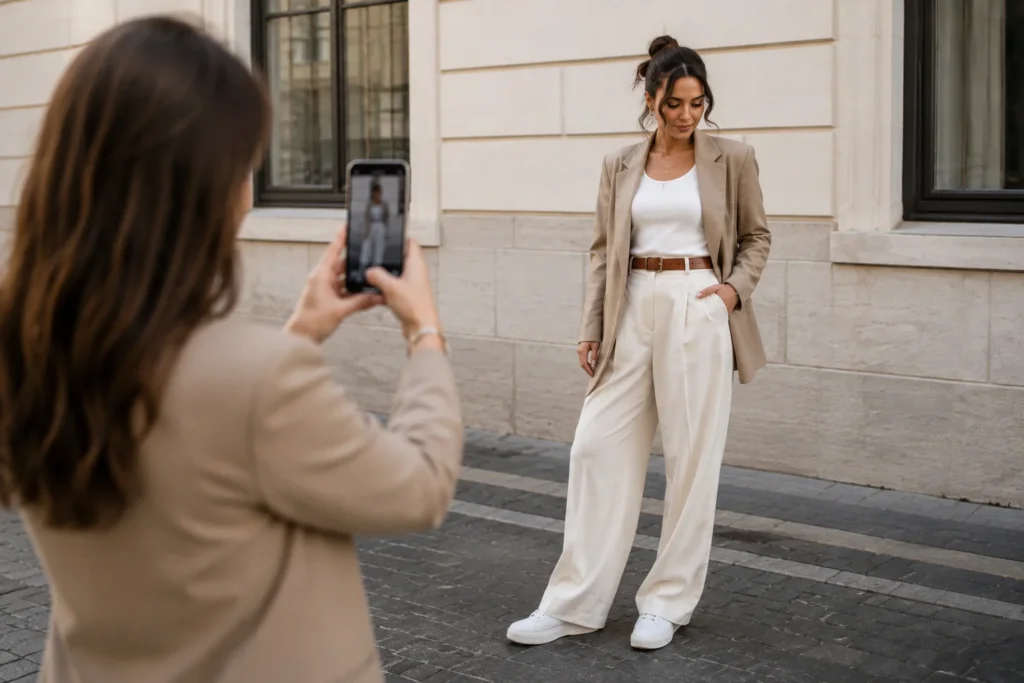
When the camera is close to the body, perspective becomes more exaggerated.
Whatever is closest to the lens can appear larger, while parts farther away can appear smaller.
That can completely change the visual balance of an outfit.
Imagine someone photographing you while holding a phone slightly above waist level and standing only a short distance away.
Your upper body may dominate the frame.
Your legs may appear shorter.
A large handbag may suddenly look enormous.
Wide trousers may seem wider than they really are.
Even the length of your coat can feel different.
The solution is surprisingly simple:
Move the camera farther away.
A little extra distance often creates a much more natural-looking full-body image.
If necessary, crop the image afterward rather than standing extremely close just to fill the frame.
Camera Height Can Change Your Entire Silhouette
Another mistake happens when the photographer automatically holds the phone near eye level and tilts it downward.
For casual snapshots, this feels natural.
For a full-body outfit, it can be disastrous.
A high camera tilted toward the floor can visually reduce the lower half of the body.
The result?
Your legs may appear shorter and your torso more dominant.
But lowering the camera too much creates the opposite problem.
Now the legs may become exaggerated and the upper body can appear unusually small.
For a natural outfit photo, start with the camera positioned roughly around the middle of the body and keep it relatively level.
You can adjust slightly depending on the look you want, but the important word is slightly.
Extreme angles create extreme proportions.
Why Oversized Clothes Are Especially Difficult to Photograph
Oversized fashion can look sophisticated in motion.
A loose blazer moves around the body.
A long coat opens as you walk.
Wide-leg trousers create flowing vertical lines.
But in a static photograph, all that volume can suddenly merge into one large shape.
This is why oversized outfits often need one visible point of structure.
For example:
A loose blazer may photograph better when the waistline of the trousers remains visible.
An oversized sweater can look more balanced with a partial front tuck.
A long coat may benefit from being worn open rather than completely closed.
Wide trousers often look cleaner when the top does not extend too far below the hips.
The goal is not to make everything tight.
It is to give the camera enough information to understand where one proportion ends and another begins.
The Hidden Power of the Waistline
One of the quickest ways to change how an outfit photographs is to change where the eye reads the waist.
This does not necessarily require a belt.
The waist can be suggested through:
a tucked shirt,
a cropped jacket,
the waistband of trousers,
a change in color,
a shorter cardigan,
or simply the point where a blazer opens.
Why does this matter?
Because photographs turn clothing into large visual blocks.
If one uninterrupted block runs from shoulder to mid-thigh, the legs can appear shorter even when they are not.
Showing just a small indication of the waist can restore balance immediately.
Before deciding that your trousers are unflattering, try changing the top first.
The trousers may not be the problem at all.
Long Tops Can Quietly Change Your Proportions
One of the most common styling issues in photographs is not size.
It is length.
A top that ends at the widest part of the hips can create a strong horizontal line.
A shirt that extends too far below a jacket can visually divide the body in an awkward place.
A sweater may fit beautifully through the shoulders but still make the entire outfit look heavy because of where its hem ends.
This is why two tops in exactly the same size can create completely different silhouettes.
When evaluating an outfit, stop asking only:
“Does this fit?”
Also ask:
“Where does this end?”
That question is often more important.
Shoes Matter More in Photos Than Most People Expect
Shoes occupy a relatively small area of an outfit in real life.
In a photograph, however, they become the visual endpoint of the entire silhouette.
A very heavy shoe combined with cropped trousers can create a strong block around the ankle.
A delicate shoe paired with an extremely voluminous outfit may feel visually disconnected.
The wrong shoe does not necessarily ruin the outfit.
But it can change where the eye stops.
Try taking two photographs of exactly the same outfit with different shoes.
You may be surprised by how much the apparent proportion of your legs changes even though nothing else has moved.
Be Careful With the 0.5× Camera
Ultra-wide phone cameras are fun.
They are excellent for dramatic architecture, interiors, travel shots and creative images.
But they are not always the best tool for judging how an outfit actually looks.
When a person is close to a very wide camera view, perspective can become exaggerated.
Parts of the body closer to the phone may look noticeably larger, especially near the edges of the frame.
This can create an impressive fashion-editorial effect when used intentionally.
But if your goal is simply to answer the question “Does this outfit suit me?”, an ultra-wide image may give you the wrong answer.
Do not reject an outfit based on one 0.5× photo.
Lighting Can Make Fabric Look More Expensive — or Much Cheaper
We often think lighting changes only our face.
It also changes clothing.
Soft directional daylight can reveal the texture of wool, linen, denim or knitwear beautifully.
Harsh overhead lighting can create deep folds and shadows that make the same fabric look uneven or bulky.
Strong direct flash can emphasize shine.
Very warm indoor lighting can change the apparent color of neutrals.
This is especially noticeable with:
cream,
white,
beige,
gray,
navy,
brown,
and muted green.
If you are trying to judge whether two colors work together, do not rely exclusively on a photograph taken under strange artificial lighting.
Check the outfit in daylight too.
Small Patterns Can Behave Strangely on Camera
A tiny check, stripe or geometric print may look subtle when you see it with your eyes.
A camera sensor has to translate that detail into pixels.
Very fine repeating patterns can sometimes become visually busy or create strange interference effects in photographs and video.
That does not mean you should avoid patterned clothes.
It simply means that an outfit designed primarily for photography may benefit from slightly larger, cleaner patterns.
If you have ever wondered why a shirt looked perfectly normal in the mirror but oddly “vibrating” on screen, the fabric pattern may be the reason.
The Bag Can Quietly Destroy the Balance
You create a beautiful long vertical silhouette.
Then you put on a large crossbody bag.
The strap cuts diagonally across the torso.
The bag sits directly at the widest part of the hip.
And suddenly the photograph feels completely different.
Nothing is technically wrong with the bag.
Its position is the issue.
Try moving it:
slightly higher,
slightly lower,
behind the arm,
onto the shoulder,
or temporarily into your hand.
One small adjustment can restore the original silhouette.
This is particularly useful when photographing long coats, dresses and monochrome outfits where uninterrupted lines are part of the look.
Stop Standing Completely Straight
This sounds counterintuitive.
We are often told to “stand straight” for photographs.
Good posture absolutely helps.
But standing perfectly square to the camera with both arms pressed against the body and both feet aligned can make even a beautiful outfit look flat.
Try a more natural position instead.
Shift a little weight onto one leg.
Allow one knee to relax.
Create a small amount of space between your arm and torso.
Turn your body just slightly rather than presenting it like a passport photograph.
These changes are tiny.
But they allow the camera to see the shape and construction of the clothes.
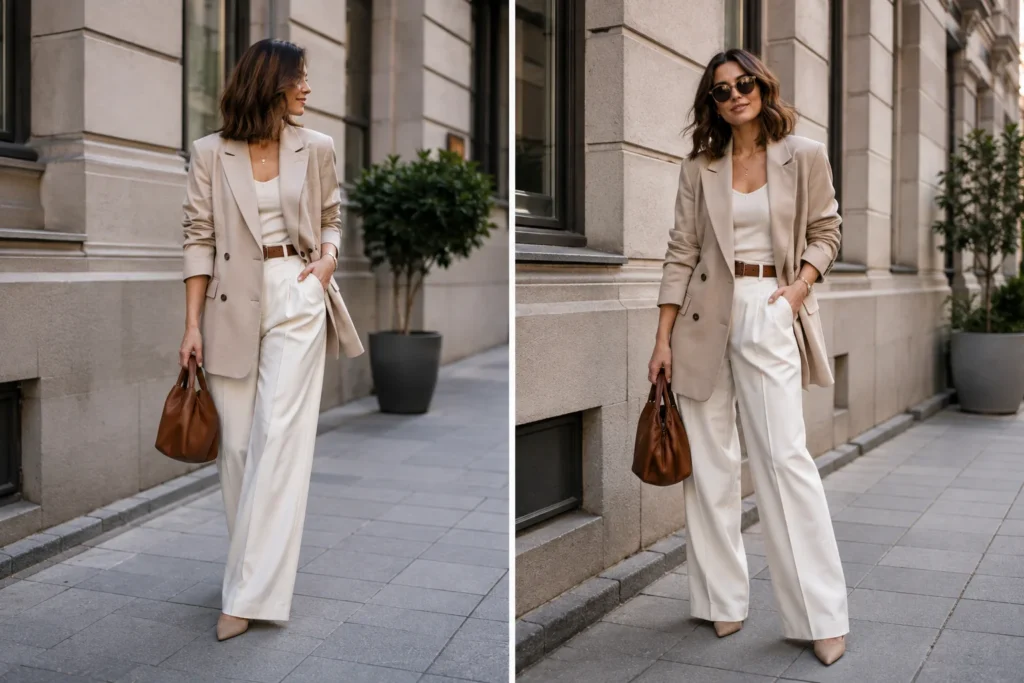
Take a Walking Photo
If an outfit was designed to move, photograph it moving.
This is particularly effective for:
long coats,
pleated skirts,
wide-leg trousers,
fluid dresses,
oversized shirts,
and lightweight knitwear.
Take several photos while walking slowly toward or across the camera.
You may discover that the outfit you disliked in static photographs suddenly makes perfect sense.
That is because clothing is not sculpture.
We wear it while moving.
Some garments reveal their best proportions only when they move with the body.
Use This 30-Second Outfit Photo Test
Before deciding that an outfit is unflattering, take four photos.
Photo 1: Stand naturally with the camera fairly close.
Photo 2: Move the camera several steps farther away and keep it level.
Photo 3: Adjust the top so the waistline is slightly more visible.
Photo 4: Take one image while walking.
Now compare them.
If the outfit looks completely different across those four photos, you have learned something important:
The clothes were never the only variable.

When the Photo Really Is Showing You a Styling Problem
Of course, sometimes the camera does reveal something useful.
Maybe the blazer really is too long for the trousers.
Maybe the sweater and skirt create too much volume in exactly the same area.
Maybe the trouser hem breaks awkwardly over the shoes.
Maybe three strong horizontal lines divide the body into sections.
Photographs are valuable because they simplify an outfit.
They show shape before detail.
Use that information.
But do not let a poorly taken photograph convince you that you need an entirely new wardrobe.
First change the distance.
Then the angle.
Then the posture.
Then one styling detail.
Only after that should you blame the clothes.
The Most Expensive Styling Upgrade Costs Nothing
Fashion advice often begins with shopping.
Buy a better blazer.
Replace your jeans.
Find the perfect shoes.
Invest in a different bag.
Sometimes those purchases make sense.
But learning how proportions behave — both in real life and in photographs — may improve more outfits than buying another five pieces of clothing.
The next time you look great in the mirror and terrible in a photo, do not immediately trust either one completely.
Move the camera farther away.
Straighten the angle.
Adjust one hem.
Show a little more waist.
Take a few steps.
Then look again.
You may discover that the outfit you were about to reject was never wrong.
It was simply photographed from the wrong point of view.